Note
ASO 101
Coming from B2B SaaS the world of consumer apps seems to operate on an entirely different set of rules (some better and others worse).
If you are considering launching a mobile app, ASO is table stakes. Here are some notes I've taken as I've tried to learn what's true, what's hype, and where the 80/20 is. This is from the perspective of someone who is already familiar with SEO.
The Core Mental Model
ASO is SEO for app stores (Apple App Store and Google Play). The ecosystem is more constrained. You're optimizing within a walled garden with fewer levers, less transparency, and fundamentally different ranking signals.
Key structural difference from SEO: in web search, you have near-infinite surface area (pages, blog posts, schema markup). In ASO, you have a tiny fixed set of metadata fields and the stores heavily weight behavioral signals (installs, retention, engagement) alongside keyword relevance.
The Actual Ranking Factors (80/20)
1. Keyword Relevance in Metadata
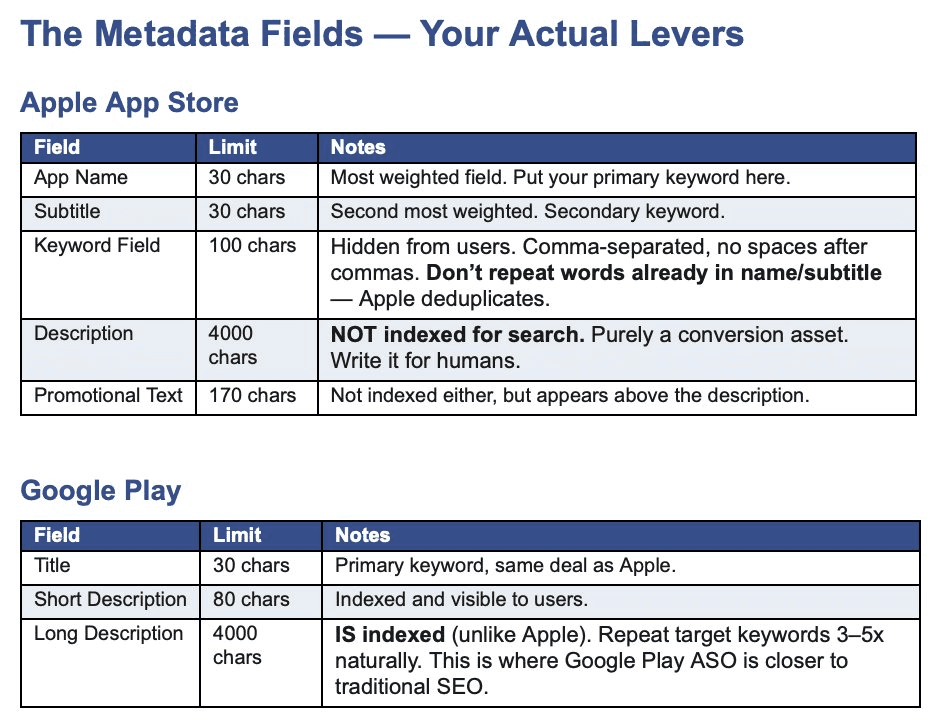
This is your on-page SEO equivalent. App name/title, subtitle (iOS) / short description (Google Play), keyword field (iOS only, 100 chars), and long description (Google Play indexes this, Apple does not). Pick the right keywords here and you're doing 40% of the work you can control.
2. Install Velocity & Conversion Rate
Install velocity = the rate of installs over a given time window, not just the absolute count. An app getting 500 installs/day for the last 3 days is a stronger signal than one that got 10,000 installs six months ago and now gets 20/day.
Think of it like freshness signals in web SEO. The stores want to surface apps that are currently gaining traction, not just historically popular. This is why launch weeks matter so much - a coordinated push (PR, social, cross-promo, paid) that spikes install velocity in a short window can bootstrap you into higher rankings, which then drives organic installs, which sustains the velocity. It's a flywheel when it works.
The stores also care about your conversion rate from impression to install. A high-converting listing gets shown more. This is the equivalent of CTR in SEO, except it directly feeds ranking.
3. Ratings & Reviews
Volume, recency, and average score. A 4.5+ with volume is table stakes for competitive categories. Consensus is that below 4.0 and you're actively being suppressed.
4. Retention & Engagement (Post-Install Signals)
This is where ASO diverges from SEO. Apple and Google both use post-install signals. If people install and immediately churn, the store learns your app doesn't deserve the ranking. This is the equivalent of pogo-sticking in web search, except it's measured over days/weeks.
How heavily is this weighted? Post-install signals definitely matter, but they're more of a slow decay/boost than a hard gate. An app with great install numbers but 80% day-1 churn will gradually lose ranking position over weeks, not instantly.
What about hard paywalls? The stores almost certainly account for the fact that different business models produce different engagement patterns. A utility app you open once a month has fundamentally different retention curves than a social app. The stores have category-level baselines - they're comparing you to your peers, not to TikTok.
That said, hard paywalls do create a real ASO tension: they tank your conversion rate (most people bounce at the paywall) and reduce your install volume. The stores see both signals. This is one of the strongest arguments for a freemium or soft paywall model from a pure ASO perspective - not because the stores punish paywalls directly, but because the downstream metrics (installs, engagement, retention) all suffer compared to a free-with-upgrade model.
5. Update Frequency
Regular updates signal a maintained app. Not a massive factor but it's a hygiene baseline.
The Conversion Assets - Your Landing Page
- Icon: Massive impact on CTR. Test it. Bold, simple, distinctive at small sizes.
- Screenshots: First 2-3 are critical since most people never scroll. Treat them like above-the-fold hero sections. Benefit-driven captions beat feature lists.
- Preview Video: Autoplays on iOS (muted). Can boost or kill conversion. A bad video is worse than no video.
- Ratings Prompt Strategy: When and how you ask for reviews is a product decision that directly affects ASO. Prompt after positive moments (completed a level, achieved a goal).
Can the Stores Be Gamed?
Negative SEO: Sending Junk Traffic to Competitors
If conversion rate matters, then driving low-intent impressions to a competitor's listing would tank their CVR. This is the ASO equivalent of negative SEO.
In practice, it's harder than it sounds. The stores do not expose a direct way to send traffic to a competitor's listing at scale. You cannot buy impressions on someone else's listing as a product.
How the Stores Mitigate This
Both Apple and Google almost certainly segment conversion rates contextually. They do not use a single blended CVR. They weight by traffic source, search term, and browse context. Your conversion rate from a branded search is evaluated differently from your CVR on a generic keyword. They also look at relative conversion performance (how you convert vs. other apps shown for the same query) rather than absolute numbers.
Not a perfectly solved problem, but not the easy attack surface it appears at first glance.
Burst Campaigns
Buying a large volume of installs in 48 hours to simulate organic traction. This used to be more effective. Both stores have gotten much better at discounting incentivized/low-quality installs. The underlying mechanic (velocity matters) is still true, but the ROI on artificial bursts has degraded significantly.
What's True vs. What's Hype
True
- Keywords in title/name are the single most impactful on-page lever.
- Conversion rate optimization (icon, screenshots) is genuinely high-ROI.
- Google Play long description indexing makes it more SEO-like.
- Localization is a massive unlock - translating metadata into 20+ languages is one of the few genuine free lunch moves in ASO.
Hype / Overblown
- "ASO tools give you accurate search volume" - They do not. Apple and Google do not share this data. Tools like Sensor Tower and AppTweak use modeled estimates. Directionally useful, not precise. Treat them like Ahrefs keyword difficulty - a proxy, not truth.
- "Backlinks help ASO" - On Google Play there is a weak signal from web authority, but nothing like web SEO. On Apple, basically irrelevant to search ranking, though referral traffic helps install velocity.
- "Keyword density in descriptions matters on Apple" - It does not. Apple does not index the description.
- "You need to change keywords every week" - Over-rotation kills you. Test in 4-week cycles minimum. Keyword rankings take time to stabilize.
- "Paid installs boost organic rankings" - This used to be more true. Both stores have gotten better at discounting incentivized and low-quality installs. It can still work as a signal but the ROI has degraded.
- "Category ranking is super important" - It drives less discovery than people think. Search and browse/featured are where the volume is.
Localization - The Underrated Power Move
Both stores have completely separate metadata fields per locale. It's not a single field with translations - it's a full parallel set of metadata for each language/region.
How It Works
- Apple App Store Connect: per-locale fields for app name, subtitle, keywords, description, promotional text, screenshots, and preview video. Supports about 40 localizations.
- Google Play Console: separate title, short description, long description, and screenshots per language. Supports 75+ languages.
The Cross-Locale Keyword Hack (Apple)
Apple does something interesting with keyword indexing across locales. For most storefronts, Apple indexes keywords from multiple localizations. For example, the US storefront indexes both your English (US) and Spanish (Mexico) keyword fields. This effectively gives you 200 characters of keywords for the US store instead of 100.
Experienced ASO practitioners exploit this by putting their primary English keywords in the English locale and secondary/long-tail keywords in the Spanish locale, even if the app is not actually localized into Spanish.
This is one of the most under-used legitimate ASO tactics and it's basically free.
Google Play: Long Description Surface Area
Since the long description is indexed on Google Play, localized descriptions in major languages give you a massive long-tail keyword surface area. Even machine-translated metadata (cleaned up by a native speaker) can capture searches in languages where competition is near-zero.
Why It Works So Well
The ROI on localization is genuinely one of the best in ASO because most developers do not bother. Competition on non-English keywords is dramatically lower. Top locales to prioritize: Spanish, Portuguese, German, French, Japanese, Korean, Chinese (Simplified), Italian, and Russian.
The 80/20 - Maximum Impact for Minimum Effort
If you're launching an app and want maximum impact:
- Nail your keyword research: Find the intersection of relevance, search volume (directional), and low competition. Long-tail first, exactly like SEO.
- Optimize title + subtitle/short description: Put your best keywords here. Do not keyword-stuff the title though; it also needs to convert.
- Make your first 3 screenshots sell the benefit: This is your conversion rate lever. A/B test if you have volume.
- Get to 4.5+ stars: Implement smart in-app review prompts after positive moments (completed a level, achieved a goal).
- Localize metadata: Even if the app is English-only, localized metadata in top markets captures long-tail searches at near-zero cost. Use the cross-locale keyword hack on Apple for bonus keyword slots.
One Big Difference From SEO to Internalize
In web SEO, you can rank a mediocre page with great technical SEO and high quality backlinks. In ASO, the product is the ranking factor. If your app has bad retention, no amount of metadata optimization will save you long-term because the stores incorporate post-install behavior into rankings.
ASO without product quality is like SEO without content quality - it might work briefly but it does not compound.